Visualizzazione post con etichetta rom. Mostra tutti i post

giovedì 21 luglio 2011

ROME - KEATS-SHELLEY MEMORIAL

"Bright star, would I were stedfast as thou art-
Not in lone splendour hung aloft the night
And watching, with eternal lids apart,
Like nature,s patient, sleepless Eremite,
The moving waters at the priestlike task
Of pure ablution round earth's human shores,
Or gazing on the new soft-fallen mask
Of snow upon the mountains and the moors-"

The wonderful film by Jane Campion has renewed Keats's memory.

In the Piazza di Spagna, at the corner on the right as one begins to climb the steps, is the house where English poet John Keats lived and died on the evening of 23 February 1821; it is now a musaeum dedicated to his memory, full of memorabilia of the English Romantic generation.

The room where Keats died is tiny, but it faces out on to the sunlit spaces of the Spanish Steps. He would have had to be a very rich man now to rent such a room.

His death-mask, which is preserved there, has a gentle tranquil smile, showing that peace came to him in the end after the agony of the last terrible months.

Apart from the relics of the romantic poets, the apartment contains a remarkable library composed of works devoted not only to himself, Shelley and Byron, but also affording a mine of information on the period and world in which they lived.


John Keats's Tombstone (Foto di Piero - Licenza Creative Commons Attribuzione)


La locandina del film di Jane Campion


Fanny Brawne, interpretata da Abbie Cornish


Fanny Brawne, interpretata da Abbie Cornish, con John Keats


Ben Whishaw nel ruolo di John Keats nel film di Jane Campion


Il film narra il folle e disperato amore di Fanny Brawne per John Keats. Il poeta è gravemente malato e oltre tutto in condizioni economiche disastrose. Pur innamorato di lei, rifiuta di sposarla.

Quando Keats parte per Roma, la ragazza si taglia i capelli e si veste come una vedova.


See also: 


ROME - SPANISH STEPS
http://johncristiani.blogspot.com/2011/07/rome-spanish-steps.html


PALESTRINA - IL TEMPIO DELLA FORTUNA
http://cristigianni.blogspot.it/2016/11/palestrina-il-tempio-della-fortuna.html


mercoledì 6 luglio 2011

ROME - SPANISH STEPS (PIAZZA DI SPAGNA) AND VILLA MEDICI

A heated discussion over how the steep slope to the church "Trinità dei Monti"  should be urbanised preceded the final execution.

The steps were designed by both Alessandro Specchi and Francesco Specchi. The project lay dormant, until Pope Clemente XI Albani renewed interest in it. The "Spanish Steps" were inaugurated in 1725.

During Christmas time a 19th-century crip is displayed on the first landing of the staircase. During May, part of the steps are covered by pots of azaleas. The steps are not a place for eating lunch, being forbidden by Roma urban regulations, but they are usually crowded with people. On March 20, 1986 a McDonalds reataurant was opened near the Spanish Steps.

In the eighteenth century the Piazza di Spagna area was known to the Romans as "er ghetto de l'Inglesi; all rich foreigners were given by them honoray British citizenship. Still today the Piazza di Spagna is one of the first ports of call  for any foreign traveller in Rome. It is the heart of the smartest shopping district and those two venerable institutions the Caffè Greco and Babington's Tea Room continue as general international rendezvous.


TRINITA' DEI MONTI


The Spanish Steps lead to the church of Trinità dei Monti, which is one of the landmarks of Rome.  It was originally built as the conventual church for the monastery of the Minims of St. Francis of Paula.
It was begun in 1495. King Charles VIII gave 347 golden scudi for its construction. Successive popes, kings of France and cardinals subscribed to its building and that of the monastery. The striking facade, with its twin belfries, was not completed for another century. The interior contains two large works by hand of Daniele da Volterra.


Trinità dei Monti di Giambattista Bassi (XIX century)


The oldest architectural feature of the Piazza di Spagna is the fountain of the Barcaccia. The delightful "old barge", sinking in the inadequate pool of water, was designed either by Pietro Bernini or his famous son, the great Gian Lorenzo (modern art historians incline towards the latter). In any case it provides an ingenious solution of the problem posed by the lack of pression in the aqueduct of the Acqua Felice, which feeds it, that rendered the more customary jets and sprays of a higher fountain impossible.


THE FOUNTAIN OF THE BARCACCIA


A little farther along in the narrow part of the square is the column commemorating the promulgation of he dogma of the Immacolata Concezione.


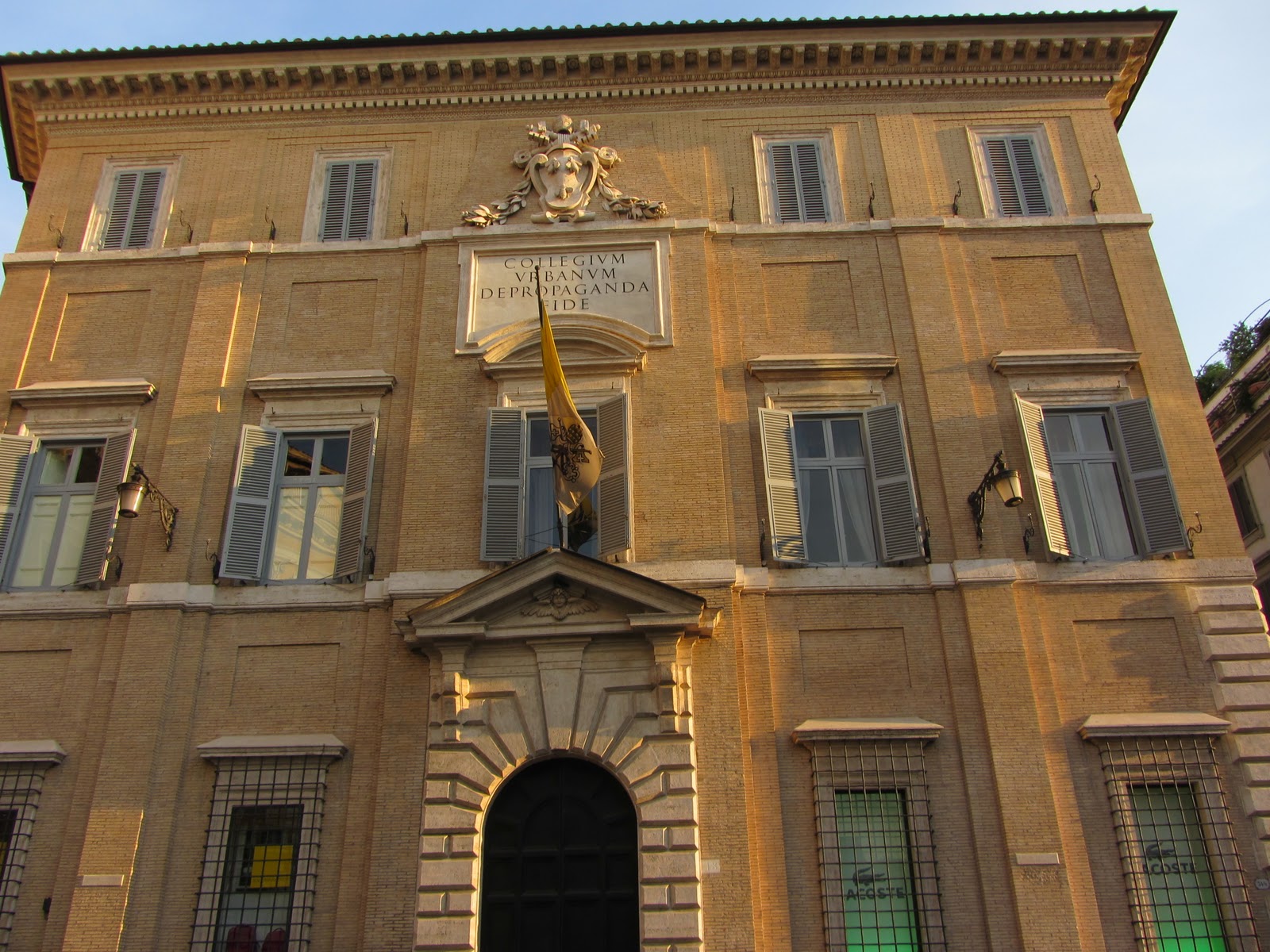
At the far end of the piazza is the vast Palace of the Congregation of the Propaganda Fide, an institution founded by Gregory XV in 1622. The Piazza di Spagna facade was rebuilt by Gian Lorenzo Bernini in 1642 - 44. 


THE SPANISH EMBASSY


The Spanish Embassy to the Holy See


VILLA MEDICI


At the left of the church of Trinità dei Monti there is Villa Medici.Since it was purchased by Napoleon in 1803, the Villa has housed the French Academy, the doyen of all the foreign schools of art in Rome. In the Villa Medici was prisoned Galileo from 1630 to 1633 by order of the Inquisition. At this time, the Villa belonged to the grand dukes of Tuscany, having been purchase by Cardinal Ferdinando de' Medici in 1580.


Close by is the gate to the Gardens of the Villa Medici.


VISTE PANORAMICHE


I CAFFE'


Babington's Tea Rooms


Il Caffè Greco


Via Condotti a Natale


Via del Corso a Natale


There are always many people in the square.

ROME - ROMAN FORUM
http://johncristiani.blogspot.it/2015/02/rome-roman-forum.html

ROMA - PIAZZA NAVONA E SANT'AGNESE IN AGONE
http://cristigianni.blogspot.it/2016/11/roma-piazza-navona-e-santagnese-in-agone.html


Vedere anche: